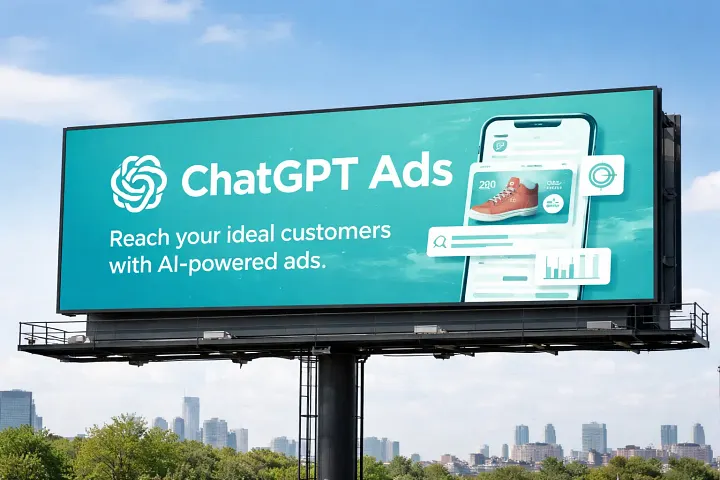
Google ads is falling.
Google ads launched in 2000. For two decades, the marketing playbook was the same: bid on keywords, appear in results, pay per click. SEO ran parallel to ads. The brands that emphasized both ads space and SEO gained serious competitive advantages.
That playbook still works. But the fundamentals are shifting underneath it.
Since 2022, people have been moving from Googling to conversations. Not “best running shoes 2026” into a search bar, but the same question typed into ChatGPT, with a follow-up, and another after that. ChatGPT crossed 900 million weekly active users in early 2026. Perplexity is growing. Google’s own search is being restructured around AI-generated answers.
ChatGPT-ads rolled out in May 2026 for all companies, that became two parallel things changing at once:
- how brands get found organically online
- how brands pay to be found
GEO is the new SEO. ChatGPT-ads are the new Google Ads. And these shifts require different responses from your brand.
Lucky for us, both GEO and ChatGPT-ads are early enough that understanding them now is a significant advantage. So let’s break down what’s happening and what to do about it.
After reading this article, you’ll leave with:
- how AI is creating a paradigm shift in how your brand can be found
- by diving into the mechanics of GEO and ChatGPT-ads, and
- what you can do about it today.
Brands are getting less traction from Google, everyday.
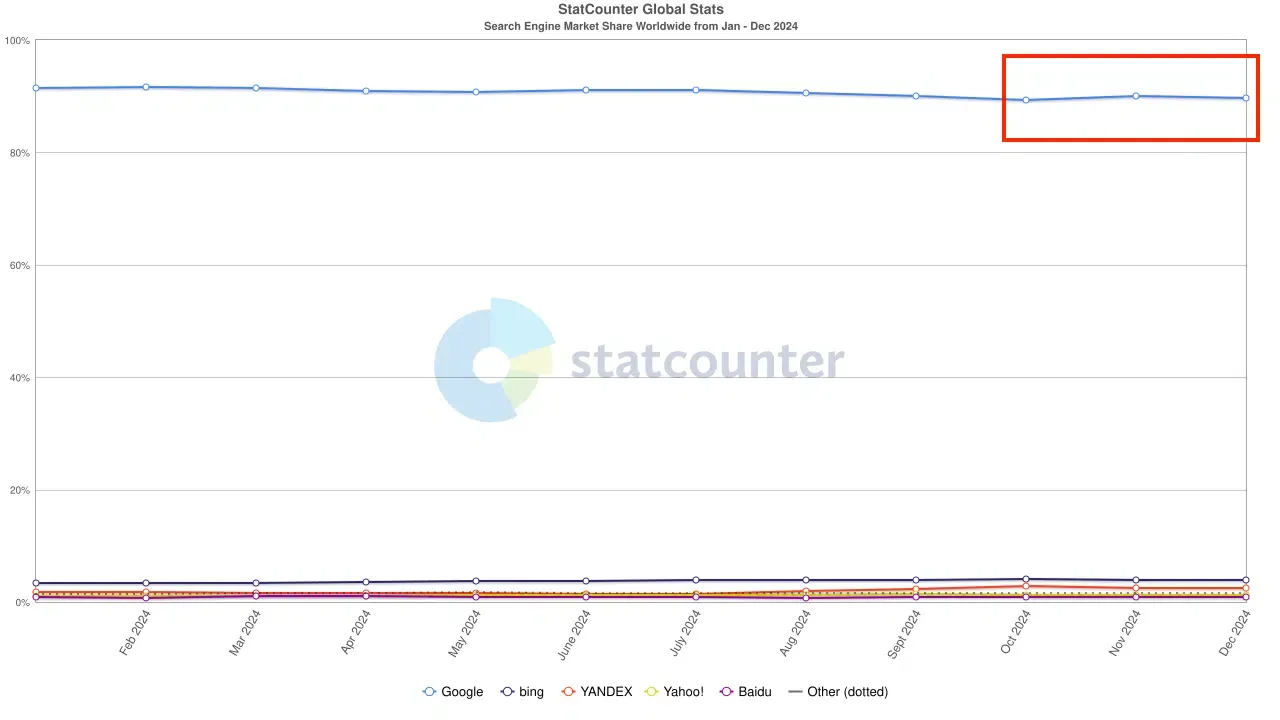
To understand GEO, let’s start from the beginning. For near a decade, Google held above 90% of global search market. That number barely moved until October 2024, when it dropped below for the first time since 2015 and kept declining through 2025. If this doesn’t sound like much, just remember that Google processes roughly 8.5 billion searches a day, so one-point shift is tens of millions of queries leaving Google.
Where did that number go? ChatGPT had 400 million weekly active users in February 2025. By February 2026, it went up to 900 million. Users didn’t switch to ChatGPT because they were told to. It was natural, because getting an answer is a better experience than getting ten links to click through. This all happened without businesses noticing. While most businesses only knew SEO (search engine optimization), a new word was needed to describe the upcoming trend.
Here’s what even more interesting: Google is disrupting itself.
AI Overviews that sits at the top of Google’s search results answer the question before the user has any reason to scroll down. That makes ranking number one on Google matter less than it did two years ago.
Ahrefs analyzed 300,000 keywords in February 2026 and found that the top-ranking page “loses 58% of its clicks when an AI Overview appears above”. That’s more than half the traffic wiped away.
60% of all Google searches end without a single click nowadays, 77% on mobile. In Google’s AI mode, where the AI answer occupies the entire screen, the zero-click rate reaches 93%.
Businesses used to build their acquisition strategy around informational content, like blog posts, FAQs etc. But those are exactly the queries that AI overviews answer directly.
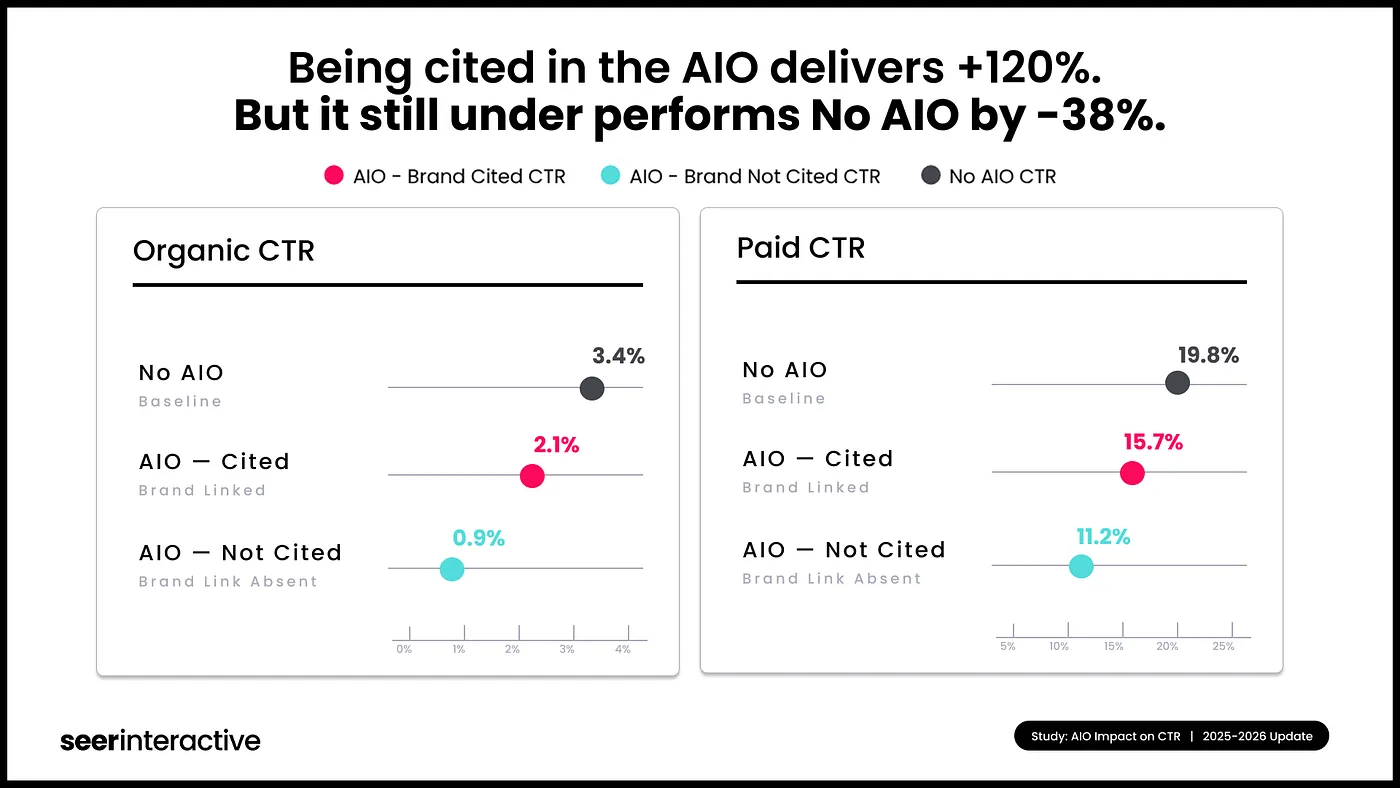
However, pages that are cited inside AI overviews get 120% more clicks per impression than uncited pages on the same result pages. It used to be a ranking game. But now, being inside the answer is completely different than being below an answer.
GEO is the next layer of SEO.
Above shows that there has been an obvious shift in how brands are found on the internet. Clicks are “disappearing” from traditional pathways like Google and appearing somewhere else: Large Language Models (more commonly known as AI).
Therefore, if the goal of a brand is no longer to rank on a search results page, but to be the source an AI pulls from, the optimization strategy has to change. The industry started calling this GEO, generative engine optimization. Which means instead of optimizing for a search engine, like Google or Bing (SEO), you’re optimizing for a generative engine (GEO), like ChatGPT.
To understand why the distinction matters, it helps to understand how the separate system works mechanically.
SEO:
- Google’s crawler visits your page, reads the content, and scores it against different signals
- that includes keywords, how fast it loads, how many other sites are link to it etc
- It outputs a ranked list. A brand’s position on that list determines how much traffic it gets.
In short, SEO optimizes for how your brand is ranked on a search engine (Google) and how much impression it gets from users.
GEO:
- Generative engine runs its own internal search and pulls a set of sources
- it summarizes each one and generates a response that weaves summaries into one coherent answer
- Your brand is mentioned or it isn’t. There is no positioning.
In short, GEO optimizes for how much your brand is showing up in AI chats, and how it’s framed as a brand.
The 3-pillar framework for GEO: Technical, Content, and Authority.
Every optimization strategy, whether for Google or for a generative engine, sits inside one of these three buckets. The pillars are the same across SEO and GEO. What changes is what each pillar specifically requires.
That means a brand doesn’t have to build two separate strategies, instead, a strong foundation serves both SEO and GEO. Here’s how the pillars break down and where SEO and GEO diverge within each.
1. Technical:
For SEO, technical means the site speed, mobile responsiveness, metadata etc. In short, Google’s crawler needs to be able to read and index the page cleanly and conveniently.
For GEO, technical means structured data. A big part of that is schema markup.
AI engines don’t read web pages the way a human does. They parse content through a process of semantic extraction, pulling entities, relationships, and facts out of unstructured text. Schema markup short-circuits that process by providing a machine-readable layer on top of the page that tells the engine exactly what the content represents, without requiring interpretation.
A study cited by Data World found that LLMs powered by structured, schema-enriched content achieve “300% higher accuracy than those relying on unstructured” text.
It’s important to note that good GEO also means good SEO. Both SEO and GEO require clean, crawlable HTML.
2. Content:
For SEO, content means targeting keywords with enough search volume to drive traffic. Keyword research, on-page optimization, metadata aligned to search intent.
For GEO, content means topic clusters. A hub page (on your website) that owns a broad topic, with supporting articles that each answer one specific long-tail query in depth.
The reason is that AI engines answer conversational questions, not returning results for short keywords. A page that directly and thoroughly answers “what do I do with my wedding flowers after the wedding in Vancouver” gets cited, instead of a page only optimized for “Vancouver florist”.
Long-tail queries matter for both SEO and GEO. The difference is that SEO treats them as keyword variations to rank for, while GEO treats them as questions to answer completely, because that’s what gets pulled into an AI response.
An example (from client work):
The client had a live website, but no blogs and no content beyond a homepage. We built a topic cluster anchored by one hub page covering the broad topic the organization owns. Under it, five supporting articles each targeting a specific question a real person would ask an AI engine. Real questions like: what happens after the event, how to arrange a pickup, where donations go, how the process works, what eco-conscious alternatives exist in the city.
Each article is structured the same way.
- The direct answer to the query appears in the first two paragraphs.
- The header structure uses questions rather than topic labels, because those headers are the retrieval anchors an AI engine uses to locate the relevant section inside a longer piece.
- The hub page embeds the core answer from each supporting article directly into its own body, so an engine crawling only the hub gets enough substance to cite the brand across multiple query types.
3. Authority:
A 2025 University of Toronto study found that AI search engines show a “systematic and overwhelming bias toward earned media over brand-owned content”, citing third-party sources roughly five times more frequently than a brand’s own website. Separately, Muck Rack’s analysis of over one million AI citations found that 82% came from earned media sources and 94% from non-paid sources.
Backlinks matters in GEO, just as SEO, because AI engines draw from the same web Google indexes. A brand with strong domain authority is more likely to be retrieved as a source than one without it. But the GEO authority layer is broader than backlinks alone.
Reddit is the clearest example of why. AI models were trained heavily on Reddit data because it represents high-signal, unfiltered human conversation at scale. A brand discussed authentically in the right subreddit has a presence in AI training data and retrieval pools that no amount of on-site optimization can replicate. The key word is authentically. A post that reads like a press release gets ignored or downvoted. A post that contributes something real to a community conversation, and happens to mention the brand in context, gets traction and stays indexed.
ChatGPT-ads is the future.
Google ads built a $300 billion industry. ChatGPT is on its way to a bigger industry.
Google’s advertising business generated $294 billion in revenue in 2025. It took twenty years to get there and it’s built on one foundational mechanic: match a keyword to a user’s search, show them an ad, charge per click. Simple, measurable, and for two decades, it’s the most reliable way to reach a user who is looking for something.
The mechanic worked perfectly, because a users search intent was the highest quality signal for a brand. An user who types “best running shoes Vancouver” into Google is telling a brand exactly what they want. That’s why advertisers pay a premium for that lead, and Google built the largest advertising business in history.
Enters ChatGPT. A ChatGPT conversation contains something a search query can never: context. Not simply what a user is looking for, but why they’re looking, what their assumptions are etc. For brands looking for consumers, that is a much stronger signal than pure keywords.
When ChatGPT launched its ad pilot on February 9, 2026, inventory opened at $60 per thousand impressions. For context, a typical Meta CPM runs around $20. NFL broadcast inventory, considered some of the most premium ad real estate in the world, runs at comparable levels. ChatGPT commanded that pricing from day one, before most businesses even knew the platform existed.
Six weeks after launch, the pilot crossed $100 million in annualized revenue with over 600 advertisers. OpenAI has shared projections with investors: $2.5 billion in 2026, $25 billion by 2028, $100 billion by 2030. Google took two decades to build its ad business. OpenAI is projecting to get a third of the way there in under four years.
How does ChatGPT ads work?
Google ads work on keywords, where a brand bid on a search term, and the ad appears when a user types it.
ChatGPT ads work on conversation context. It works on a description of the types of conversations a brand wants its ad to appear in. A florist might set context hints around wedding planning, event gifting, or sustainable celebrations. OpenAI’s system reads active conversations in real time and evaluates four signals:
- What topic is being discussed
- What problem the user is trying to solve
- Where the user is in the decision process
- What intent signals appear in the language
When a conversation matches closely enough, the ad gets served.
It’s important to note that ChatGPT ads is completely independent from the organic answer. That means the sponsored result does not influence the original output answer. First, ChatGPT generates its organic answer, then, a separate ad system evaluates the conversation and decides whether to show a sponsored placement and what to show. The two systems don’t interact during answer generation, meaning the ad cannot influence what ChatGPT says.
The placement appears in a clearly labeled, subtly tinted box beneath the response. Advertisers receive aggregate performance data only: impressions, clicks, and conversions. Individual conversations are never shared.
What a brand controls, in short
- Context hints describing target conversations
- Ad creative
- Objective: Reach (brand awareness, CPM) or Clicks (performance, CPC)
- Budget, with no minimum spend requirement as of May 2026
On the pricing, the platform launched at a $60 CPM maximum bid for Reach campaigns. For Clicks campaigns, the recommended starting CPC bid is $3 to $5. For context, the average Meta CPM runs around $20. Doubling a budget doesn’t double exposure. It increases a brand’s share of relevant conversations up to the limit of available qualifying inventory. That’s a meaningfully different dynamic from Google or Meta, where more budget generally means more reach.
Ok, so how do I set up a campaign?
By this point you might be wondering, what can my brand do today to get started?
Getting access is straight forward.
- Go to ads.openai.com
- Fill in business information
- Wait for manual account review
As of May 2026 (and our experiences), review process takes roughly a week. Once approved, the Ads Manager opens up with a familiar structure. Let me show you what it looks like to start your first ad campaign.
1. Campaign
Name the campaign, choose an objective (Clicks or Reach), select a country, and set a budget. The minimum daily budget is CA$25. Budget type is locked once the campaign is created, but the amount can be adjusted anytime.
2. Ad group and ad level
At the ad group level, a brand sets a maximum CPC bid and a destination URL. Then the context hints field: an open text box where a brand describes the conversations, topics, or keywords where their product or service is relevant. The platform describes it explicitly as guiding matching rather than exact-match targeting. It’s optional, but leaving it blank means the system relies entirely on the ad creative and destination URL to infer relevance.
3. Review
A full summary of everything before launch: campaign name, objective, location, daily budget, schedule, ad group name, CPC bid, destination URL, context hints, and the ad creative.
One thing worth noting from inside the platform: a CA$5 CPC bid showed a “Strong Delivery” signal, meaning the bid was competitive for that ad group. That’s a low number relative to what mature platforms like Google charge for comparable intent.
OpenAI reached out directly. Here’s what they said.
In May 2026, we received an email from OpenAI’s GTM team, the team leading the early rollout of ChatGPT ads. They were moving from a closed pilot to a wider pool of brands and reached out to one of our clients directly.
The program overview they shared had three points.
- an initial self-service cohort across priority advertisers, meaning this is still an early, curated group, not a fully open marketplace
- native, contextually relevant ad units within ChatGPT
- what they called a “light lift to get live”: minimal budget commitment, an order form, and compliant creatives. That’s the full barrier to entry right now and it’s extremely low
Note that they described the ad as “reaching users before they’ve made a decision”. That’s a precise description of what sets ChatGPT-ads apart from its competitors.
They also noted that they were “actively finalizing partners”. That means the platform is still being built, and brands that are in now are shaping how it develops.
TL;DR
- Google’s search market share dropped below 90% for the first time since 2015. ChatGPT went from 400 million to 900 million weekly active users in twelve months.
- 58% of clicks disappear from the top Google result when an AI Overview appears above it. In Google’s AI Mode, the zero-click rate is 93%.
- Pages cited inside AI answers get 120% more clicks per impression than uncited pages on the same page.
- GEO optimization runs on three pillars: technical (schema markup, structured data), content (topic clusters targeting long-tail conversational queries), and authority (earned media, community presence, third-party citations).
- ChatGPT ads launched self-serve in May 2026. A CA$5 CPC bid currently shows “Strong Delivery.” OpenAI is projecting $100 billion in ad revenue by 2030.
- ChatGPT ads are generated independent from the organic answers.
- You can get started on ChatGPT-ads with around a week of account review and a CA$25 daily minimum.
What we’re building at Victory Velocity.
Thank you for reading. As someone who’s been deeply obsessed in this space, I’d love to share my thesis on the industry:
the marketing ads space is experiencing a paradigm shift, the same way Google and Meta ads reshaped how brands reach customers in their eras. The difference this time is that AI adoption is moving exponentially faster, and the compounding advantage for brands that build their presence now will be proportionally larger.
At Victory Velocity, we help companies get ahead of this paradigm shift. We work with brands to build their AI presence from the ground up. That includes structuring their sites so AI engines can read and cite them correctly, building content that answers the questions their customers are already asking AI, tracking how models talk about their brand over time, and running ChatGPT ad campaigns that reach customers mid-conversation before a decision is made.
If any of this is relevant to your business, or just want to exchange notes, feel free to reach out below.
- Talk to us at victoryvelocity.ca
- Book a time: calendly.com/kadenyeung/new-meeting